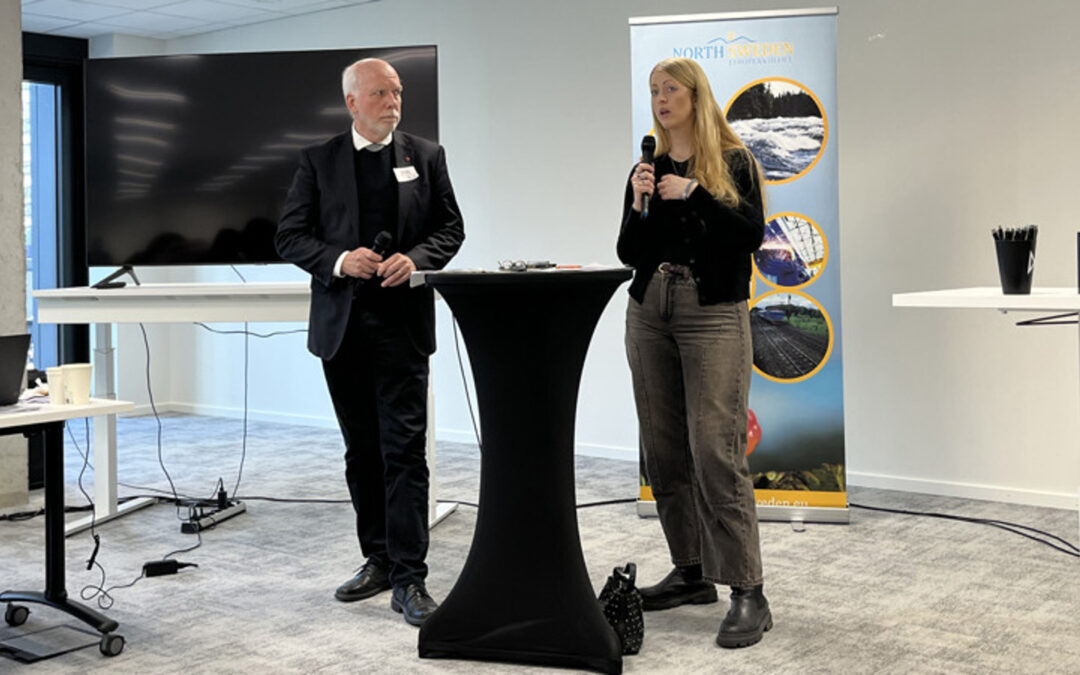
EU parliamentarian Sofie Eriksson discussed risks and opportunities with Anders Öberg, chairman of the regional board in Norrbotten.
The EU’s new budget, governance and transition policy will have a direct impact on northern Sweden. But how is still a topic for negotiation. The Europaforum Northern Sweden meeting in Brussels on December 4 was an opportunity to raise our concerns, proposals and perspectives with those in power within the EU.
Northern Sweden is not just a periphery – we are part of Europe’s response to climate challenges, resilience and competitiveness. The meeting in Brussels was attended not only by around 60 representatives from the four Norrland counties, but also by invited politicians and managers with great influence within the EU. The interest in participating reflects the important role northern Sweden plays in Europe’s industrial, green and territorial development.
There was a lot of anticipation when EFNS first welcomed Gaetano d’Adamo from the European Commission’s budget department. The EU is currently negotiating a new multiannual financial framework. d’Adamo presented the Commission’s proposal and described the new Competitiveness Fund as a crucial innovation:
– For me personally, it is the Competitiveness Fund that is the real innovation and revolution.
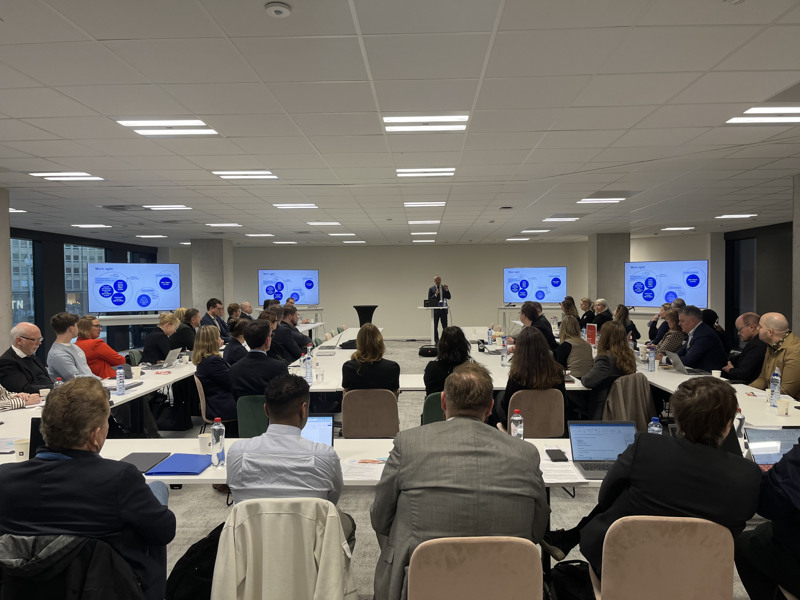
Gaetano d’Adamo presented and discussed the proposal for a new long-term budget with around 60 people present from northern Sweden.
The new structure will be more flexible. But it also means that more responsibility may end up at the national level. Jonas Andersson, chairman of the political network Europaforum Norra Sverige, raised a clear concern:
“One of our biggest concerns is the lack of regional and territorial partnership… there is a risk that we will end up with 27 different development agendas, instead of one, as national governments become more involved in this,” he said.
“Moved to densely populated areas”
The proposal for a new cohesion policy would mean that funds would no longer be earmarked for specific areas, such as the sparsely populated regions of northern Sweden. Felicia Stanescu from Commissioner Raffaele Fitto’s cabinet assured that the regions would still have a strong role.
“The consultation and involvement of regional partners is a statutory obligation,” she said.
At the same time, local representatives expressed concern that promises made at EU level are not always followed up in practice. Carina Sammeli, chairwoman of the Luleå municipal council, stressed the importance of what the Commission says about the role of the regions being firmly put on paper and not sweeping promises.
“We have always had a friend in the Commission, but sometimes we have to fight at the national level. And that means that anything that is not clearly written down in documents is going to be difficult for us to point out, because we won’t be able to send them to them in five years and say, ‘This is what we agreed,’” she said.
Within EFNS, there is also concern that the new cohesion policy will be a reform that benefits large cities and those parts of the country where the large voter groups are located.
“We are currently receiving signals that this funding will be moved from sparsely populated areas to more densely populated areas. So this is already underway,” said Isak Utsi, chairman of the municipal board in Arjeplog municipality.
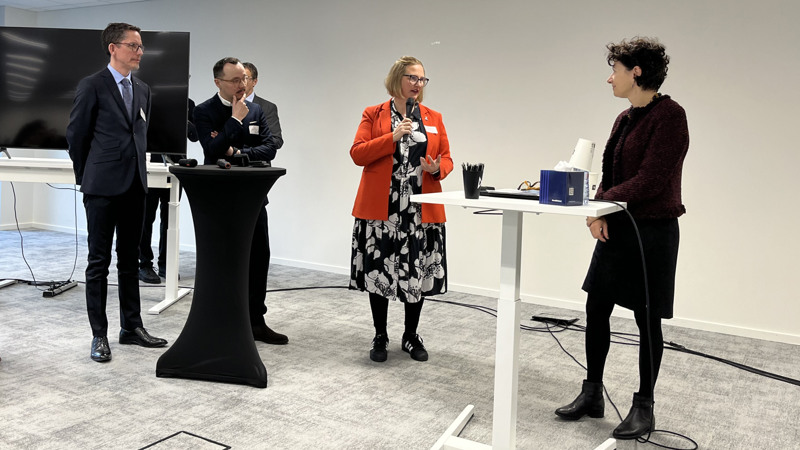
Carina Sammeli, chairwoman of the Luleå municipal board, raised concerns about what the commitments should be worth in practice with Felicia Stanescu. EFNS rapporteurs Isak Utsi (S), Arjeplog municipality, and Johan Loock (M), Jämtland Härjedalen, listen.
Concerns about the future of agriculture
Ingrid Rydberg from LRF’s Brussels office warned that the new budget will mean major changes to the EU’s agricultural policy, the Common Agriculture Policy (CAP).
A calculation example shows that a farm in northern Sweden could lose 19 percent in support.
– We are very dissatisfied with the budget proposal that has been submitted. Partly, of course, the cuts. But above all, this fact that agriculture is being put into some kind of national-regional partnership plan. That may sound good, but who is really in charge? Is it the EU or the Swedish Minister of Finance?, said Ingrid Rydberg.
She also highlighted the connection between agriculture and forests, and warned that the deforestation regulation could also affect agriculture. Many farmers use their forests to enable investments in agriculture.
“At the center of the transition”
Sofie Eriksson (S) is a Member of the European Parliament and sits on three important committees: REGI (Committee on Regional Development), ITRE (Committee on Industry, Research and Energy) and PECH (Committee on Fisheries). She stressed that northern Sweden is not a peripheral region in practice:
– The northern part of Europe and northern Sweden in particular will be at the very center of the enormous industrial transition. We show that green transition in industry is not a PowerPoint – it is happening for real.
She also warned of a worrying trend in parliament:
– It’s bad from a Swedish perspective and especially bad for northern Sweden. Companies have invested enormous sums based on the fact that it will pay off to be at the forefront.
Anders Öberg, chairman of the regional board in Norrbotten, highlighted the need for real regional influence over how structural funds are distributed.
“It must not just be a consultation. Otherwise we risk losing the opportunity to steer regional development,” he said.
Important to take regional differences into account
The EU is facing a time when both geopolitics and climate challenges are pressing the Union from multiple directions at the same time. At the center of this work is EU Commissioner Jessika Roswall, responsible for the environment, water resilience and a competitive circular economy – a portfolio that coincides directly with many of the issues that are crucial for northern Sweden.

Åsa Ågren Wikström, Vice President of EFNS, presents position paper to Commissioner Jessika Roswall.
The Commissioner described the year as one of the most challenging in a long time:
– It has been incredibly intense. It is a difficult geopolitical situation. War on our continent. Trade wars. Conflicts in general. We have struggled with the economy in the EU, our growth is not that great.
When Roswall spoke about the circular economy, she emphasized the potential of Europe’s transition:
“This is about transforming our societies and our economies from linear to circular. We need to use our resources in a more sustainable way. There is enormous potential here,” she said.
Northern Sweden’s industries, natural resources and innovation environments are important pieces of the puzzle in the EU’s quest for green global competitiveness. Therefore, it was also significant that Europaforum Northern Sweden was able to submit three documents on our political position on the EU Deforestation Regulation, the Water Resilience Strategy and the proposal for a single, overarching fund in the EU’s next long-term budget. All with clear messages that legislation must take regional differences into account and provide continued tailored support to northern Sweden in order for us to be able to contribute fully.
– We want to be part of the solution. Not the problem, said Åsa Ågren Wikström, vice president of EFNS.
Text: Sara Stylbäck Vesa
Photos: Julia Bergsten